HealthLit AI
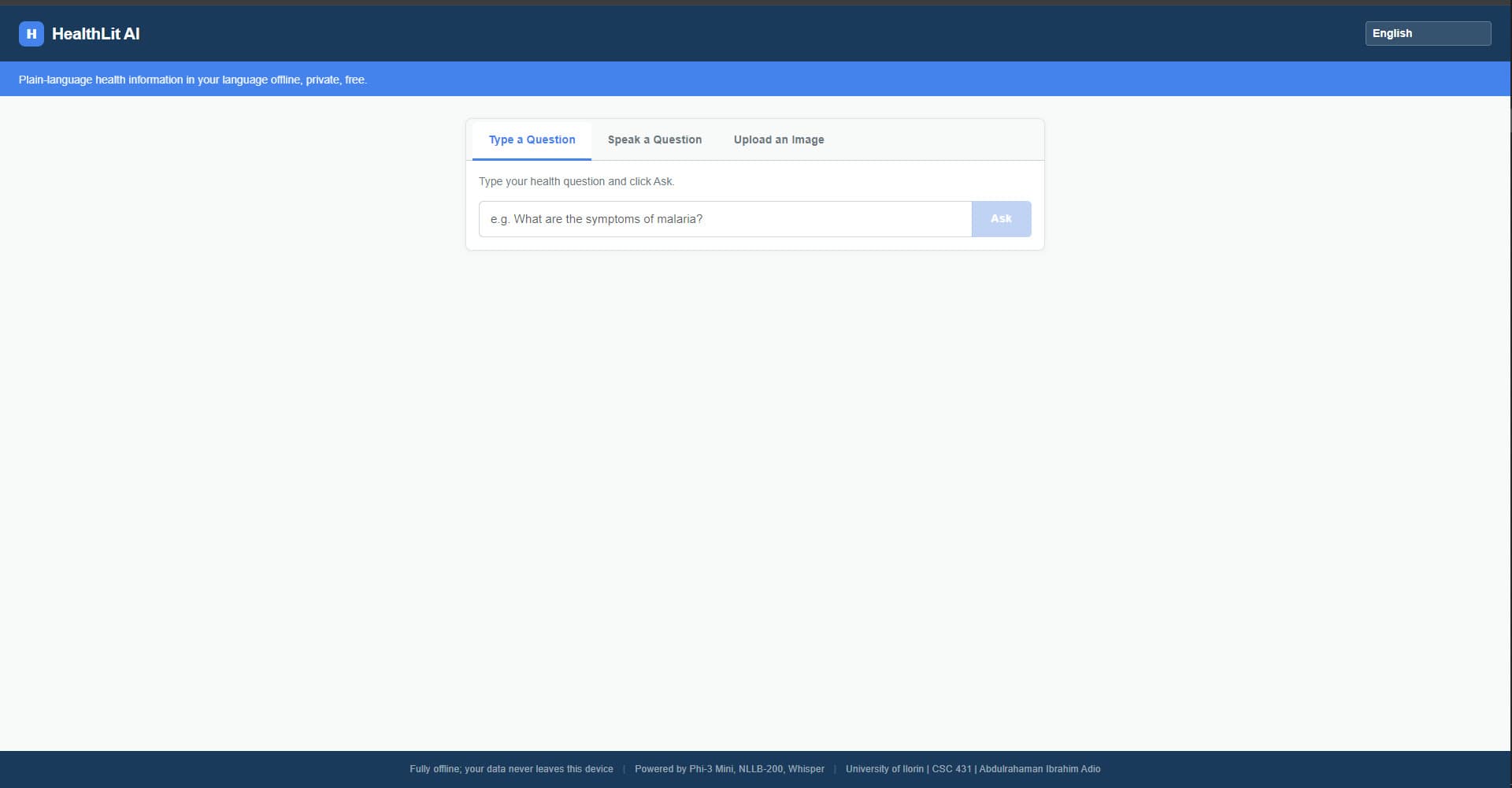
An offline, multilingual AI health-literacy assistant
The Idea
Make trustworthy health information genuinely accessible in low-resource settings — no internet dependency, no English-only assumption, no opaque AI answers.
The Problem
Health information online is usually dense clinical English, assumes constant connectivity, and isn't available in Yoruba, Hausa, Igbo, or Nigerian Pidgin — a real barrier in low-resource Nigerian settings.
The Solution
A locally-run retrieval-augmented generation pipeline over a curated knowledge base of 12 WHO/FMOH health topics, answering text, voice, or image questions with a small local LLM, translated into the user's chosen language — with patient data never leaving the device.
My Role
Solo — built the RAG pipeline (LangChain + ChromaDB retrieval over the WHO/FMOH knowledge base), the Django REST backend, the React frontend, and wired in speech, vision, and translation as input/output modalities around the core model.
Challenges
Getting a small local model (3.8B parameters, no cloud fallback) to answer reliably and stay grounded in the source documents instead of hallucinating, and chaining four separate models — language, translation, speech, vision — into one coherent offline pipeline without a GPU-backed server.
Status
Prototype — a working application built and presented as a university seminar / final-year project (CSC 431, University of Ilorin, 2026). Not deployed as a public product.
Key Features
- Accepts health questions via text, voice, or image
- Answers grounded in a curated 12-topic WHO/FMOH knowledge base — malaria, diabetes, hypertension, maternal health, and more
- Responds in English, Yoruba, Hausa, Igbo, and Nigerian Pidgin
- Runs entirely offline on a standard laptop, no internet required
- Patient data never leaves the device
Technology